Bhoomika Jain.


Relationships | Design Brief
To understand the nuances of Human Relationships, explore various perspectives and establish narratives through a systems thinking approach
Humans are social beings. It is in our nature to form and maintain relationships with others. At the same time these relationships form us. With numerous external forces influencing the nature of our relationships and the dynamic nature of relationships, how might we enable people to create meaningful bonds?
Duration: 10 Weeks
Team: Individual Project | Solution in Collaboration with Trisha Malakar
Key Insights Derived
Relationships and Well being affect each other while simultaneously getting affected by each other.
Our formative years become pivotal in shaping our coping mechanisms.
Lack of healthy coping mechanisms, as result of upbringing and development in formative years
Outputs Delivered
1. Sculpt: A platform to help parents understand their child's social and emotional development through their formative years.
2. A Gentle Reminder: An initiative to nudge individuals to ask the right kind of questions to prompt conversations about mental well-being to form meaningful relationships.
3. Community Wellbeing: Using existing resident data and connecting parents with elderlies who voluntarily want to spend time with children.
(The solution set is still a work in progress)
Systemic Research Methodology

Expert Interviews
Depth Interviews
Ideation
Interpersonal Relationships

Familial
Friendships

Romantic
Professional
An interpersonal relationship is a strong, deep, or close association or acquaintance between two or more people that may range in duration from brief to enduring. This association may be based on inference, love, solidarity, regular business interactions, or some other type of social commitment.
Humans are social beings and it is in our nature to form bonds with people as we go through our lives. Everyday we meet and interact with people, some of whom become integral parts of our lives. Interpersonal relationships are the strong connections we feel with those closest to us.
Broadly, there are four types of relationships each of us form.
Exploring Narratives
01. Relationships from an evolutionary perspective
The human brain has evolved for social relationships. But although people are born ready to love and relate to other people, relationships differ in several important ways.
A modern evolutionary approach is based on the seminal work of Charles Darwin. This approach suggests that, just as the forces of natural selection can shape morphological features, so too can those forces shape psychological and behavioral tendencies. An evolutionary approach maintains that human and nonhuman animals inherit brains and bodies equipped to behave in ways that are fitted to the demands of the environments within which their ancestors evolved.

To view narrative in detail, click here
02. Relationships through time

Throughout history, there have been pivotal moments that have transformed the way we interact and bond with each other. Starting with the plough, that conceived the institution of marriage, the steam engine that changed the way we work, advancements in technology pertaining to our daily lives like the car and appliances like the fridge giving a degree of freedom to the housewives who otherwise would toil their days away doing the household chores. These also served to give form to suburban life and the much debated concept of teenage. In the domain of relationships, a remarkable change came with the invention of the contraceptive pill, that essentially enabled people to choose when to have children and resulted in late marriages and pregnancies, all driven through the power of choice.
Assisted reproduction enabled people to have children outside the constraints of nature. Now having a child is based on the intent of parents and not dictated by the biology of our beings.
Coming to more recent times, the advent of social media and dating apps have all but changed the way we interact with each other. Having a thousand or more followers on Instagram is now a sign of social success and support. Finding love has never been easier, just at the swipe of your fingers.
But are these really helping our generation, which is the saddest set of 20-30 year olds to have ever existed?
In 2004, India reported that 4.91 million people in the country both lived alone and felt lonely (Bubna, 2020).
More recently, the Centre for the Study of Developing Societies (CSDS) released findings that 12 percent of Indian youth reported feeling depressed often, and 8 per- cent reported feeling lonely quite frequently (CSDS et al., 2017).
Loneliness is a systemic emergence and asymmetry in the highly dynamic system of human relationships
Let us take a closer look at loneliness

Systems Map
In order to understand how each of these four types of relationships operate with each other and impact the individual, a systems map was visualised.

So what happens to the Value System?

What becomes evident is that with the increasing transactional nature of relationships, the value system is deteriorating. There is an increase in interpersonal conflicts and all of this is driven by the characteristics of the people that form the relationship.
A question arises; what defines these characteristics?
Asking this question helped me identify a boundary for my systemic interventions
Setting Boundaries
Family Systems
Children in their growing years learn a lot from the environment that they grow in and if faced with physical or emotional abuse, it can sabotage their mental well being. With time, the abuse manifests into dysfunctional interpersonal relationships, ruining their life down the line.

Nuclear Families
Out of 19.31 crore households, 9.98 crore were Nuclear
Census 2001


Nuclear Families
Out of 24.88 crore households, 12.97 crore were Nuclear
Census 2011
In India, the number of “lone mothers” is rising, with 4.5% (approximately 13 million) of all Indian households run by single mothers.
- 2019-2020 Report by UN Women
Relationships and Wellbeing
Relationships and Well being affect each other while simultaneously getting affected by each other.
Together, they form a Causal Loop, which becomes pivotal to an individual's social and emotional growth.


Causal Loop
Relationships and wellbeing: how are they related?

Triggers
Emotions
Response/
Reaction
Our formative years become pivotal in shaping our coping mechanisms. These are largely influenced by the nature of relationships we share with our family, and community at large, making these a defining characteristic for our future relationships and mental wellbeing.
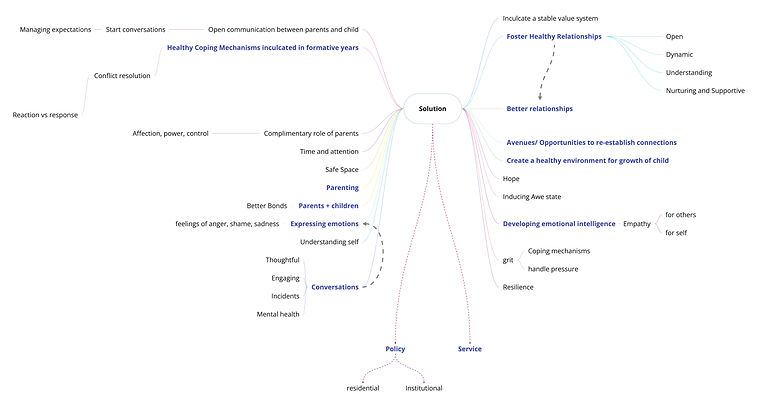
Solution Map
In order to understand and articulate the solution, we created a solution map
What points can we leverage?
Relationship between parent/s and child
Imbibing emotional intelligence
Healthy coping techniques
Intent to form meaningful connections
Developing healthy interpersonal relationships
Lack of societal and community protection
What kind of impact do we want to make?
Raising an emotionally intelligent generation
Improve overall quality of life and reduce healthcare costs
Stable value system from an early age
A meaningful community
Solution Set
How might we do this?
Designing the brief:
-
How might we help parents understand their child's emotional and social development?
-
How might we help parents design a safe environment for open, thoughtful, and meaningful communication with their children?
-
How might parents aid in the create a stable value system for nurturing healthy relationships?


Design Directions

02
Sculpt
A Gentle Reminder
Community Wellbeing
01
03
A platform to help parents understand their child's social and emotional development through their formative years.
An initiative to nudge individuals to ask the right kind of questions to prompt conversations about mental well-being to form meaningful relationships.
Using existing resident data and connecting parents with elderlies who voluntarily want to spend time with children.
To view solutions infographic, Click here
01
Sculpt
Sculpt was designed keeping the 4E framework at its core: Educate, Express, Engage, Empower

Educate
A platform for parents to learn about the social emotional growth of their child

Express
Learning healthy coping mechanisms right from the beginning

Engage
Different activities that the parent and child can indulge in to strengthen their relationship

Empower
By creating healthier relationships in the formative years
Target Audience
-
Young millennial parents
-
Residing in urban areas
-
Willingness to establish a a good relationship with their child
-
Aware about the impact of mental health to our daily lives
How Sculpt works:


*The design of the platform is in progress
Limitations we foresee:
-
At the moment, this platform would be useful only up till the age of 10-12 years, as at the onset of puberty the child would go through numerous physical, mental, and emotional changes that would require to be dealt with differently
-
The parents might encounter difficulties if the child has special needs. Though the app would serve as the first sign odf distress with respect to the child's social and emotional growth, this could also be a false alarm.
02
A Gentle Reminder
A gentle reminder is an idea to bring in nudges at regular touch points in our daily lives. In our fast paced lives we forget to nurture our wellbeing an consequently our relationships. A gentle reminder serves to urge you to ask yourselves and the people around you the right questions, questions that open up conversations and create healthier lives.

Community Wellbeing
03
Community wellbeing is a concept that integrates pre existing information on community management and security apps with the idea of creating healthier and happier communities. To young parents it provides authentic, trustworthy, and safe caregiver for their offspring their absence. To the elderly residing in the communities, it gives company to combat loneliness, and to the younger generation, it provides the strong ties to our cultural roots that have gone missing.
Key Stakeholders


How it works:
To view project document, Click here